Solar trailer – Solar power trailers are turning up on more worksites, farms and remote jobs, often as a quieter replacement for a diesel generator. Most of them get there behind a Ute.
That makes towing the first thing to get right, because a power trailer is heavy, and a Ute loaded with tools and crew is already carrying plenty.
Know your Ute’s towing limits
The braked towing capacity on the brochure is only one of several limits that apply. Transport for NSW lists them plainly: the loaded trailer must not exceed the rated capacity of the towbar and coupling, the vehicle’s maximum towing capacity, the trailer’s own maximum loaded mass, the vehicle’s gross combination mass (GCM) where the manufacturer supplies one, or the tyres’ rated capacity. The lowest of those figures is your real limit.
Tow ball download and payload
The weight a trailer puts on the tow ball counts against your Ute’s payload. The WA Department of Transport’s safe towing guide suggests tow hitch download of around 8 to 10 per cent of the trailer’s loaded mass, and notes that it must be included in the tow vehicle’s gross vehicle mass. A ute already loaded with tools, fuel and two workers can run out of payload before it reaches its towing limit.
What a solar power trailer carries
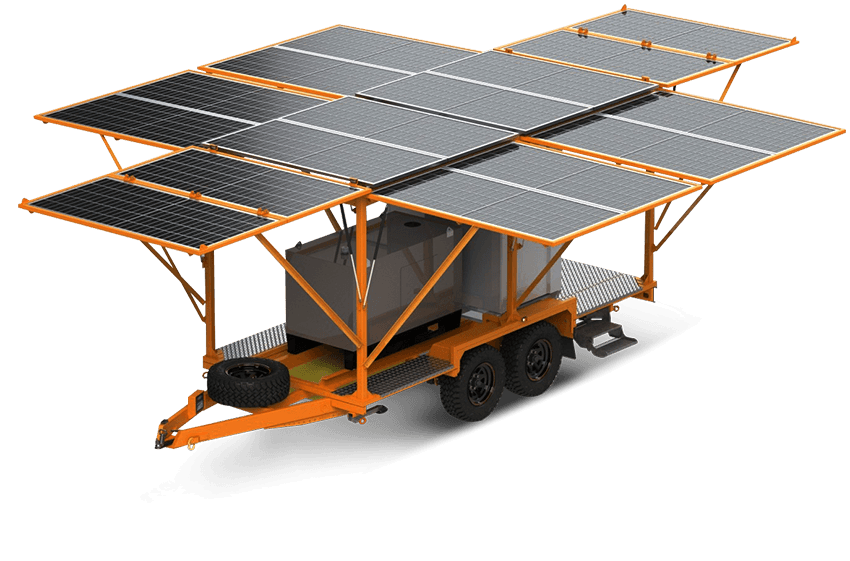
A solar power trailer packs panels, a battery bank, an inverter and often a backup generator onto one chassis, which is why its weight deserves a close look. Battery banks are dense, and steel frames built for rough roads add more. Check the trailer’s aggregate trailer mass on its compliance plate, not just its empty weight, before you match it to a vehicle.
For crews comparing options, the key question is whether you are buying or hiring a solar trailer you can tow behind a ute, or a larger unit that needs a truck. Valen’s V-Trail, for example, sits on an engineered off-road trailer with a gross tare weight under 3,500 kg. Even so, confirm the loaded figure against your own Ute’s ratings before towing.
Setting up when you get to site
Pick a spot with clear sun for most of the day, firm level ground and room to deploy the panels without blocking access. Shade from trees or site sheds cuts output more than most crews expect. Chock the wheels and level the trailer before unfolding anything, since many units have panels that open out well beyond the chassis.
Run cables away from vehicle paths, keep the inverter end shaded where you can, and check the battery state before connecting loads. If you are unsure how to size or deploy a unit for your site, suppliers such as Valen Power can talk through loads and runtime before you commit.
A quick checklist before you hitch up
Five minutes with the paperwork saves a fine, or worse, on the highway.
- Confirm the trailer’s loaded mass on its compliance plate.
- Check the lowest of your Ute’s towing capacity, towbar rating and GCM.
- Weigh or estimate the tow ball download and count it against payload.
- Check that the trailer brakes, lights and safety chains work.
- Plan where the trailer will sit on site before you leave.
Get these right and a solar trailer becomes one of the easiest pieces of site gear to move.