
The Hume Highway between Sydney and Canberra is about three hours if you are on your own. With a dog in the back it is closer to four and a half, and that gap is the single thing most owners underestimate on their first long trip.
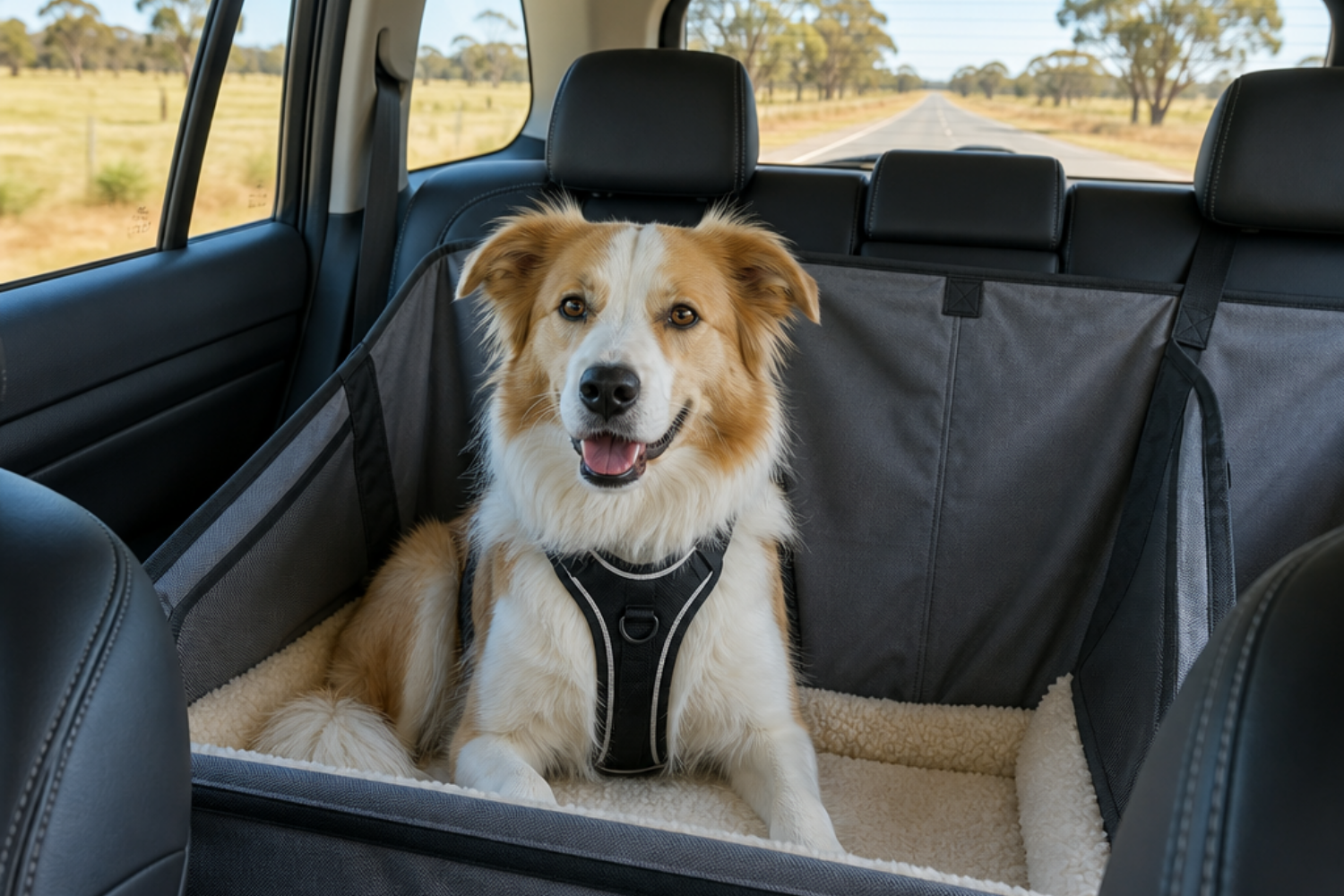
It is not that the driving is slower. It is that the stops change. You are pulling over for a toilet break, a drink, a stretch and a sniff, and none of those happen on your schedule. Once you plan the trip around that rather than against it, the whole thing becomes considerably less stressful.
Plan the route around the stops
Break the drive into shorter blocks between towns that actually have somewhere for a dog to get out — grass, shade, bins, and enough distance from the traffic that you are not white-knuckling the lead. On the Hume, Mittagong and Goulburn both work well. On the Pacific Highway heading north from Newcastle, the rest areas vary enormously in quality, so it pays to check before you commit to a stretch.
Time the main meal well before you leave and keep to light snacks on the road. Toilet stops become roughly predictable when the feeding routine has not been disrupted, and predictable stops are the difference between a calm trip and a fraught one.
If your dog is not yet settled in the car, build up to it. A few shorter runs over a couple of weekends teaches the dog that the car means a long quiet stretch rather than an event.
Setting up the back
A crate sized so the dog can lie down and turn around, anchored to existing tie points or through a seatbelt so it cannot shift under braking. Bedding thick enough to take the bumps. None of that is surprising.
What people miss is noise. The area directly over the wheel arches is significantly louder than the rest of the boot, particularly on the coarse-chip surfaces you hit south of Marulan, and a dog that seems unsettled for no obvious reason is often just sitting on top of the loudest part of the car. Moving the crate forward by thirty centimetres, or putting a folded blanket underneath it, makes more difference than most owners expect.
Get the airflow moving past the dog rather than onto it. A vent aimed directly at a crate will chill an animal over three hours even when the cabin feels comfortable to you.
What ends up in the front
The console fills up on a long drive, and cup holders are the first casualty. A full cup in a car with a dog in the back is a bad combination — you brake for something on the road, and now you are cleaning the centre console at a servo outside Yass.
Which is why a lot of drivers have moved to things that do not spill at all. Mints, nuts, chewing gum, and increasingly the small tinned formats that have come across from Scandinavia — pouches you keep under your lip rather than in a cup holder, which take up almost no room and cannot be knocked over. Whether that appeals is a matter of taste, but the container problem is real and worth solving before you set off rather than at the first roadhouse.
Rest stops and overnight with your dog
Offer water at every single stop, even the short ones. A collapsible bowl that lives permanently in the boot removes the decision entirely.
One habit worth building: occasionally pull over without letting the dog out. It teaches the animal that a stop is not automatically playtime, which takes a surprising amount of heat out of the real breaks later in the day.
For anything multi-day, book the accommodation before you leave. Finding a place that takes dogs at seven in the evening in a country town is a specific kind of misery, and it is entirely avoidable.
Plan around the dog rather than the clock, sort the back of the car properly, and a long drive stops being something to endure.